Barbell Shoulder
Press — Strongmen
Style
How the lifting giants of the 1950s and 60s built cannonball delts
While an effective abbreviated routine will already work the shoulders through compound pressing and pulling movements, the typical trainee can sometimes benefit from dedicated overhead work. The strongmen of the 1950s and 60s knew exactly which exercise delivered the best results.
Overhead pressing with a barbell is the name of the game.
Four press variations —
choose the one that suits you.
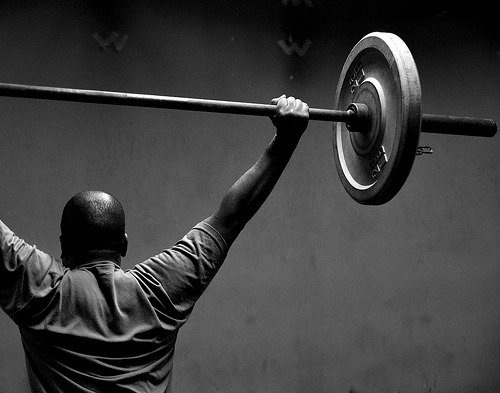
The overhead barbell press comes in four main variations. All are effective. The seated options are not offered as a way to make the exercise more strict — they are offered as a way to take strain off the lower back. The task is to find which variation you can work hardest and perform most comfortably.
Military press — standing
The classic overhead press. Full-body involvement, natural loading path, maximum strength transfer to other lifts.
Military press — seated
Reduces lower back loading. Allows strict focus on shoulder mechanics without stabilising the whole body.
Press behind neck — standing
Requires shoulder flexibility. Approach with caution and begin with very light weights until the range of motion is comfortable.
Press behind neck — seated
Combines the lower back protection of the seated position with the shoulder emphasis of the behind-neck path.
If the press behind the neck causes any discomfort or concern, switch to the front press without hesitation. The front overhead press is the safer variation and produces comparable shoulder development for the majority of trainees.
How to press like a strongman.
-
Train with serious weight
The strongmen of the 1950s and 60s were not cautious with their overhead pressing. Randall J. Strossen documented how Mel Hennessey performed an extremely strict standing press behind the neck with 300 pounds. The lifting giants of the era — Paul Anderson, Chuck Ahrens, Doug Hepburn — were all capable of pressing close to 400 pounds behind the neck.
Documented overhead press performances- Mel Hennessey — strict standing press behind neck, 300 lbs
- Paul Anderson — behind neck press, approaching 400 lbs
- Chuck Ahrens — behind neck press, approaching 400 lbs
- Doug Hepburn — behind neck press, approaching 400 lbs
The typical trainee will never approach these numbers. But they provide a clear demonstration of what the movement is capable of producing — and they are an argument for taking overhead pressing seriously rather than treating it as an accessory movement.
-
Begin light and earn your form
When beginning the barbell shoulder press — particularly the press behind the neck — start with weights that feel almost too light. The behind-neck press requires genuine shoulder flexibility and places the joint in a position that punishes poor form. Approach it with patience. Build the range of motion before the load, and the strength gains will follow without the shoulder problems that impatient loading creates.
-
Manage frequency — abbreviated is best
The overhead press is an excellent exercise, but added on top of a vigorous abbreviated programme where the chest, back, and legs are already being worked hard, it can accumulate pressing volume that the shoulders cannot sustain. A more prudent approach is to periodically substitute the overhead press for the dip exercise or your bench press. This keeps the shoulder stimulus active while preventing the overuse that sidelines most persistent pressers. Overtrained shoulders do not recover quickly — protect them.
The rotation principle in tip 3 — substituting movements periodically to sustain progress without accumulating excess — is one of the management strategies within the Minimum Effective Strength System.
The barbell overhead press built the shoulders of the strongest men of the 20th century. Applied with the right variation, the right loading, and the right frequency, it will do the same for you.
If building serious shoulder strength within a managed, sustainable programme resonates with how you want to train, the Minimum Effective Strength System includes overhead pressing within a complete movement framework built for long-term use.