Hardgainer
Routine — Genetic
Giants and the
Right Response
Mike Mentzer's three-tier framework for hard gainers — and the single principle that governs all of it
Understanding whether you are a hard gainer begins with understanding what a hard gainer is not. The clearest way to establish that boundary is to examine someone at the opposite extreme of the genetic spectrum — someone for whom recovery is so rapid and the adaptive response so pronounced that almost any training produces results.
Marvin Eder is that person. His training and its implications set the context for everything that follows.
Marvin Eder — the super-responder
at the far end of the spectrum.
To understand what a hard gainer is, it helps to establish what a hard gainer is not. Marvin Eder — the Biceps from the Bronx — sits at the opposite extreme of the genetic spectrum from the typical hard gainer. His training volume, frequency, and results were not merely impressive. They were physiologically extraordinary.
The genetic gifts that allowed Eder to train in a way no ordinary trainee could replicate.
- Best dip 434 lbs
- Daily training volume Up to 7 hours
- Training frequency Daily — sometimes multiple sessions
- First year competitive result 2nd AAU Mr America Junior
What made Eder a super-responder was not simply that he was strong. It was his recuperative ability — the speed at which his body recovered from training stress and converted that stress into adaptation. He could train for seven hours, return the following day, and do it again. Most trainees cannot train for 45 minutes without requiring 48 to 72 hours of recovery before the next meaningful session.
This difference is not a matter of effort or discipline. It is genetics. And the practical implication flows directly from it — a programme designed for Eder's recuperative capacity will not produce the same results for a trainee with average or below-average recovery. It will produce overtraining, stagnation, and the gradual loss of the strength and size it was intended to build.
How to know if you are a hard gainer —
four specific indicators.
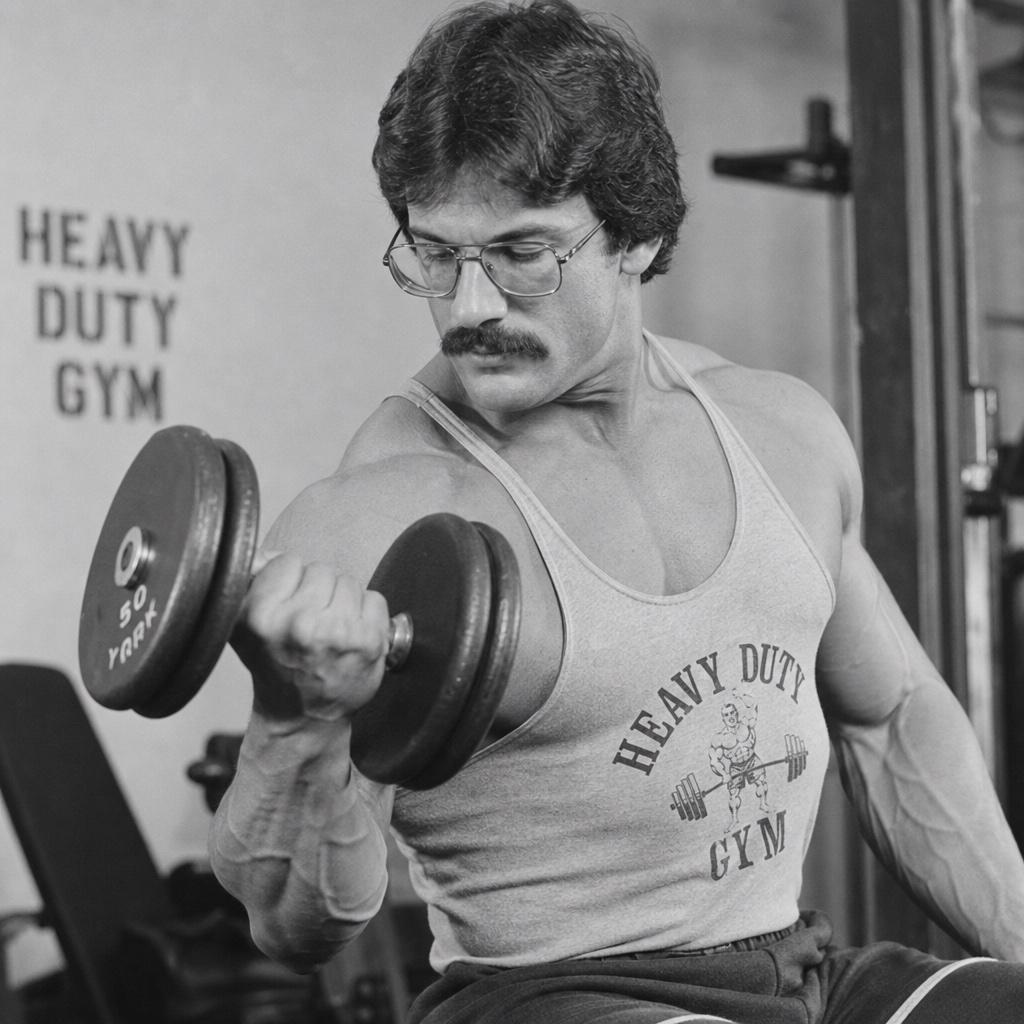
Mike Mentzer, whose Heavy Duty system addressed the hard gainer's situation more directly than any mainstream programme of the era, emphasised that genetics determines the ceiling of what training can produce. For the hard gainer, what matters is identifying the specific training parameters — volume, frequency, and recovery time — that their genetics actually support, rather than the parameters that work for Marvin Eder.
If two or more of these apply consistently, the training response needs to be adjusted accordingly.
- Consistent training effort produces little or no measurable strength increase over a period of months on a standard programme
- Persistent fatigue or declining performance between sessions — not feeling recovered before the next session is due
- Soreness and joint discomfort that lingers beyond 48 hours after training, suggesting the recovery window is longer than the programme allows
- Any reduction in training volume or frequency produces an immediate improvement in progress — the most direct evidence that the previous programme was exceeding the individual's recovery capacity
The harder a gainer you are, the less room for error you have in your training. The margin between sufficient stimulus and excessive stimulus narrows. The consequence of exceeding it — lost gains, persistent fatigue, eventual regression — becomes more immediate.
Mike Mentzer — Heavy DutyThe Minimum Effective Strength System is built around the minimum effective stimulus — the smallest training dose that produces the full adaptive response. For the hard gainer, this is not a compromise. It is the correct approach by definition.
Three tiers of hardgainer training —
reducing until the recovery window is met.
Mentzer's practical response to the hard gainer's situation was a progressive reduction framework — starting from a minimal programme and reducing further until the training parameters matched the individual's actual recovery capacity. The framework has three tiers, each representing a further reduction in volume and frequency.
Start at tier one. Move to tier two if progress stalls. Move to tier three only if tier two is still too much.
-
Tier one — consolidated programme
Five exercises every 72 hours
The starting point for most trainees who have identified themselves as hard gainers. Five compound exercises performed once every three days — significantly less volume and frequency than mainstream programmes, sufficient to trigger adaptation in most hard gainers.
-
Tier two — reduced consolidated programme
Three exercises every 96 hours
For trainees who find tier one still exceeds their recovery capacity — persistent fatigue, stalled progress, or declining performance despite the reduced volume. Three exercises every four days provides the minimum stimulus with a longer recovery window.
-
Tier three — super-consolidation
Two exercises once per week
Reserved for the most extreme hard gainers — trainees for whom even tier two produces overtraining symptoms. Two compound exercises performed once per week only. Used sparingly and only when tiers one and two have been genuinely tried and failed to produce progress.
The key principle running through all three tiers is the same — match the training demand to the individual's actual recovery capacity, not to the recovery capacity of a genetic super-responder. Tier three is not a sign of failure or inadequate genetics. It is the correct training response for the trainee whose physiology requires it. For the complete account of Mentzer's Heavy Duty system, see the Mike Mentzer training page.
Whether tier one, two, or three applies to you, the principle is identical — brief, compound, progressive training with adequate recovery. The Minimum Effective Strength System applies this principle within a structured framework that can be adjusted to the individual trainee's recovery capacity.