Barbell Squat Exercise —
King of Exercises
The fastest route to big arms, powerful shoulders, and a muscular chest
Most people training to build their body think about arms, shoulders, and chest — and consider legs an afterthought. Those who do train their legs often rely on the leg press or leg extension machine. Almost none of them squat.
This is the typical trainee's number one mistake — and it has been known for over half a century.
Why heavy squat work builds
your whole body — not just your legs.
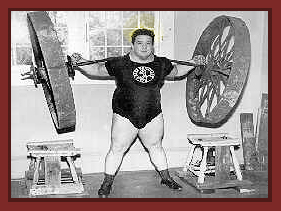
Heavy squat training is the fastest route to big arms, powerful shoulders, and a muscular chest. This sounds paradoxical — but it was proved conclusively over half a century ago.
"Experience has proven beyond any doubt that the most certain means of expanding the chest is through the medium of strenuous leg exercise, and it has likewise been the experience of those who have tried out this theory that improvements of the shoulders and arms will in time follow when the standard of the legs and torso have been raised."
Mark BerryMark Berry — coach of the American weightlifting team at both the 1932 and 1936 Olympics — added over 50 pounds of muscular bodyweight to his own frame through intensive squatting. His students made comparable gains. Berry was said to have ushered in a new era of strength training as a direct result of his emphasis on the body's largest muscle group.
Others would soon follow, including the man many consider the strongest in history — Paul Anderson — who discovered the benefits of squats early and built an extraordinary physical foundation on them.
Building leg muscles like a Titan.
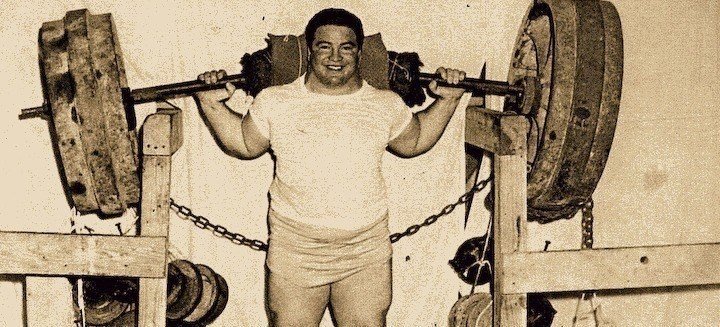
The Toccoa teenager began strength training as a 5'9", 190-pound football player looking to improve his athletic performance. Training almost exclusively on the barbell squat, Anderson soon weighed 275 pounds and was squatting close to 600 pounds. His progression from there was extraordinary.
- 1953 — surpassed Doug Hepburn's best 763 lbs
- November 1953 — new benchmark 820 lbs
- Mid-1950s — peak squat 900 lbs
Anderson's 763-pound squat came at a time when many authorities were calling Doug Hepburn — whose best was 665 pounds — the strongest man who ever lived. The numbers tell the story of what exclusive, focused squatting can produce when applied with genuine intent over time.
The squat is the anchor movement of the Minimum Effective Strength System — chosen for precisely the reason Berry identified a century ago. No other single movement produces as much whole-body adaptation for the effort invested.
What the strongest men say about the squat.
"Of all the exercises used to develop body power, one stands alone. I am referring to the deep knee bend or squat. No other single exercise can give the trainee greater overall strength in return for the time and effort involved."
Doug Hepburn — Paul Anderson's great rival"Yes, the king of exercises, the squat, will help your overall gains more than any movement."
Robert Kennedy — bestselling strength authorBerry, Anderson, Hepburn, Kennedy — four authorities across a century of strength training, all pointing to the same movement. If you want to build that movement into a complete, structured system, the Minimum Effective Strength System is where it lives.