Squat Training —
A 1930s Secret That
Still Works Today
How Mark Berry added 50 pounds of muscle to his students at staggering rates
Mark H. Berry served as coach of the American weightlifting team at both the 1932 and 1936 Olympics. His most widespread and enduring contribution to strength training was not a programme or a periodisation scheme — it was a single insistence: heavy squats.
How Berry ushered in a new era.
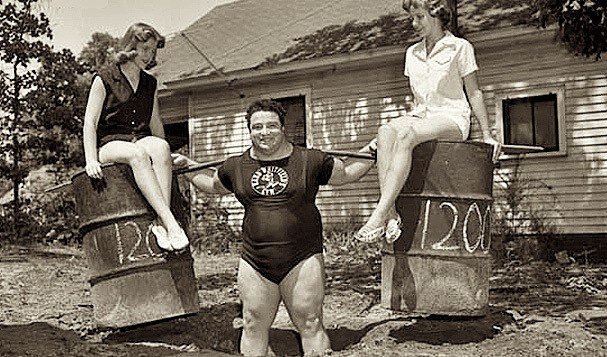
Berry added over 50 pounds of muscular bodyweight to his own slim frame. His students made comparable gains. He was said to have ushered in a new era of strength training — all from a single-minded focus on one movement.
With squat racks and heavy flat-footed squats in the 300–500 pound range, Berry's students began gaining muscular bodyweight at rates that seemed impossible by the standards of the time. As editor of Milo magazine, Berry's publications were flooded with dramatic accounts of ordinary people building extraordinary physiques using basic equipment and simple exercises.
Barbells, dumbbells, and kettlebells — nothing more.
Squats, deadlifts, presses, snatches, cleans, jerks, continentals, and straddle lifts. The emphasis on proven compound movements — the squat above all — produced results that more complicated programmes could not match.
What heavy squat training produces.
Building muscle size was only one of the dividends Berry's approach delivered. The physiological benefits of intensive squat training extended well beyond the legs.
- Improved digestion and assimilation of foods — leading to greater overall health
- Mechanics of respiration increased through vigorous leg work
- Blood circulation significantly boosted
- Chest development enhanced as a direct result of leg training
- Endurance expanded across all physical activity
In the same way all boats rise with the tide, effective strength training positively impacts the whole of the body — not just its trained parts.
Berry's discovery — that one movement, applied with genuine effort and progressive loading, produces whole-body adaptation — is the same principle behind the Minimum Effective Strength System.
As productive today as it ever was.
Squat training can produce the same results today that it produced for Berry and his students in the 1930s. The movement has not changed. The adaptation it triggers has not changed. The strongmen who followed Berry — Paul Anderson and Doug Hepburn among them — rewrote the record books on the back of this one exercise.
The 1930s secret is not really a secret at all. It is a principle that has simply been forgotten and rediscovered by every generation of serious lifters. The squat works. It has always worked. It will continue to work for anyone willing to apply it consistently and with genuine effort.
If you want to build a complete training framework around the squat and the other proven mass builders Berry championed, the Minimum Effective Strength System is where that structure lives.